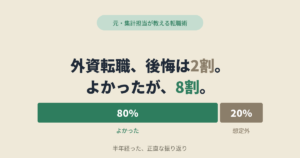
私は27歳のとき、日系金融大手から外資メーカーに転職しました。年収は500万から800万に上がり、書類選考は応募した5社すべて通過、最終内定は2社からもらえました。
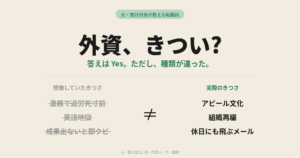
転職活動を始める前、外資の面接は怖いと思っていました。英語の圧迫面接、ロジカルな詰め、奇問難問——SNSにある「外資面接 怖い」のイメージそのものです。
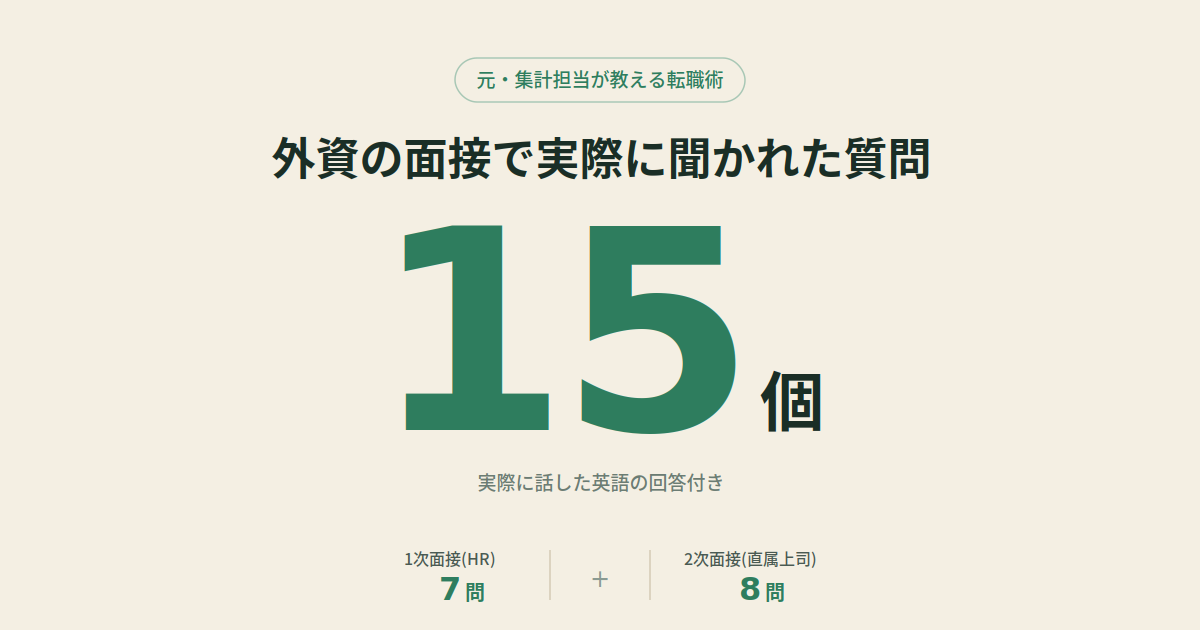
でも、実際に受けてみたら拍子抜けでした。聞かれたのはほぼ全部、答えを準備しておけば普通に答えられる質問ばかり。今回は、私が実際に外資メーカーの面接で聞かれた質問15個を、当日話した英語の回答ごと全部出します。
外資の面接は2段階構造でできている
外資の面接は、ステージごとに「見ている観点」が完全に違います。これを理解せずに同じ準備をすると、どちらかで落ちます。
| ステージ | 相手 | 形式 | 見られているもの |
|---|---|---|---|
| 1次 | 人事(HR) | 電話 or オンライン、英語 | 英語が話せるか、議論の相手になりえるか |
| 2次(最終) | 直属上司 | 事前データ送付→当日プレゼン、英語 | 業務遂行力、成果を出せるか |
ポイントは、1次は「外さなければ通過する」フィルターであるのに対し、2次は「実務で勝負する場」だということ。1次でいくら頑張っても加点は限定的、逆に2次でしくじったら一発アウト。配分を間違えないことが大事です。
1次面接(HR・英語)で聞かれた質問7個
1次面接は人事担当者との英語面接でした。所要時間30分。完全に英語ですが、ものすごく速くて高度な英語が要求されるわけではありません。
見られているのは、①英語が全くできない人を弾く、②議論の相手になりえる人物かの2点だけ。難しく構えず、地雷(無遠慮、ロジックがない、会話が噛み合わない)を踏まないことを意識すれば通ります。
Q1. Tell me about yourself.(自己紹介)
私が実際に話した内容(抜粋):
Thank you for the opportunity to introduce myself. I currently work as a data analyst at a major Japanese financial services company. Over the past several years, I have specialized in data-driven business improvement, particularly focusing on implementing Tableau for data visualization, managing KPIs, and conducting quantitative data analysis.
自己紹介で意識したのは、「経歴の羅列」ではなく「自分のテーマ」を最初に置くこと。私の場合は冒頭で「data-driven business improvement」と一言定義してから、その文脈で実績を並べました。
Q2. Why are you considering a change?(なぜ転職を考えていますか)
I have learned a great deal and grown professionally in my current role at a major financial services company, particularly in data analytics, KPI management, and Tableau implementation. However, I am seeking new opportunities for growth and impact that are difficult to achieve in my current environment.
One of the main reasons is the structural challenge of low profit margins in the industry I am currently in. Due to intense competition and the nature of the business, profit margins are relatively small. As a result, it is difficult to allocate significant budgets for large-scale marketing campaigns or promotional activities. Much of the competition focuses on customer acquisition through targeted solicitations, but there are clear limitations on how much can be invested in innovative or impactful marketing initiatives.
This environment has made me realize that I want to work in a setting where I can leverage my data analysis and KPI management skills to contribute to more ambitious, large-scale projects and strategies.
転職理由は、前職の悪口にせず、業界の構造的な事情で語るのがコツです。「人間関係が悪い」「上司が嫌い」だと感情的に聞こえる。「業界の利益率構造的にこれ以上の投資余地がない」と言うと、ロジカルかつ前向きに聞こえます。
そのうえで「だからこそ、より大きな投資ができる環境で働きたい」と前向きに着地させる。Q3の志望動機への自然な橋渡しになります。
Q3. What interests you about this role?(なぜこのポジションですか)
What interests me most about this role is the opportunity to use advanced data analytics to directly impact business strategy and performance on a large scale. I am particularly excited by the prospect of working with diverse and complex datasets, and using tools like Tableau to create actionable insights that help drive revenue growth and operational efficiency.
This position’s focus on KPI management and price-promo analysis aligns perfectly with my background. In my current role, I have enjoyed building systems to monitor KPI progress and visualize performance trends. I find it very rewarding to see how data-driven insights can influence decision-making and lead to tangible business results.
Q2の不満点と、Q3の志望理由を一本のストーリーでつなぐこと。「前職では大規模投資ができなかった」→「貴社では大規模なデータと予算で動ける」というつながりです。バラバラに答えると一貫性がなく見えます。
もう一つのコツは、応募ポジションの実務内容を、自分の経験ワードで言い換えること。求人票に「KPI management」「price-promo analysis」と書かれていたら、そのまま引用して「自分の経験と完全に一致する」と返す。これは相手のJD(ジョブディスクリプション)を読み込んでいる証拠になります。
Q4. What sets you apart from other candidates?(他の候補者との差は?)
What makes me unique is my experience in managing KPI progress by leveraging vast and complex datasets generated by financial services transactions. We process hundreds of millions of transactions, with rich customer attributes such as demographic and income segments. This allows me to analyze from multiple angles.
I also have experience with statistical approaches, such as using cohort analysis to measure the sales contribution of different customer cohorts. In short, my experience analyzing large-scale financial datasets is what sets me apart.
「強み」の質問は、応募ポジションで活きる切り口を1つに絞るのが正解。私の場合は「巨大データセットを扱った経験」に絞り、その裏付けとして「コホート分析の実務経験」を1つだけ添えました。
あれもこれもと並べると、強みの輪郭がぼやけます。「これだけは他の候補者にないはず」というポイントを1点だけ尖らせる。
Q5. What is your current and expected salary?(現年収・希望年収)
My current annual salary is around 5 million yen including overtime and bonus. For this role, I would like to follow your standard salary range based on the position level.
1次の段階で具体的な希望額を確定させないのが鉄則。向こうのレンジに合わせるスタンスを示しておくと、後の交渉余地が残ります。年収交渉のテクニックは別記事で詳しく書きます。
Q6. How much English do you use at work?(業務で英語をどれくらい使いますか)
I use English regularly at work. I have weekly online meetings with overseas research agencies and partners, daily email communication, and I conduct independent research using English sources. I’m comfortable in business-level conversation, though Japanese is still my native level.
ここではTOEICスコアより使用頻度を答える方が刺さります。スコアは履歴書を見ればわかるので、面接では「実務でどう使っているか」を聞かれている、と捉えるのが正解。
Q7. When can you start?(入社可能日は?)
I would need approximately two months from the offer date to properly hand over my current responsibilities.
「明日からでも」と言うと前職の管理が雑な印象を持たれかねないので、現職への誠実さは見せておきます。2ヶ月が標準。
2次面接(直属上司・ジョブ面接)で聞かれた質問8個
2次面接は最終面接で、相手は入社後の直属上司。形式が独特で、面接の2日前に実データが送られてきて、当日プレゼンするスタイルでした。会話は1次同様、すべて英語です。
私の場合は、事業部の売上データとキャンペーン情報が渡されて、「分析して、パフォーマンス報告と今後の打ち手を資料にして話してくれ」という指示。土曜にスタバで資料を作りました。質問はプレゼン中・プレゼン後の対話で出てくる形です。
Q8. Could you walk me through your career so far?(キャリアの全体像)
Sure. I joined my current company right after graduation and was assigned to the international business division. For the first three years, I was responsible for KPI management of overseas business expansion — setting annual targets, tracking monthly progress, and identifying gaps with the field teams. After that, I shifted into quantitative analysis, building dashboards to give management real-time visibility into the business. In my fourth year, I took on the inbound business strategy as our flagship growth pillar after the COVID recovery.
1次でも自己紹介はしていますが、2次でもまた聞かれます。1次よりは少し詳しく、自分の専門性が今のポジションにどう活きるかを意識して話すと刺さります。
Q9. Why did you choose your current company when you graduated?(なぜ前職を選んだか)
When I graduated, I was looking for a role where I could work on cross-border business and contribute to expanding Japanese services overseas. My current company offered exactly that — a chance to be in the international business division from day one. The experience I built there — managing KPIs across markets, working with overseas partners, and analyzing data to inform strategy — is the foundation I’m bringing to this role today.
これは「キャリアの一貫性」を見ている質問。新卒選択の理由 → 前職での成長 → 今の応募の理由を一本の線でつなげると、「行き当たりばったり」ではなく「考えて動いている人」に見えます。
Q10. Tell me about your biggest achievement.(これまでで一番大きな成果)
この記事で一番強調したいのはここです。
外資面接で評価されるのは、「すごい分析をした話」ではありません。「自分の動きで会社の数字が動いた話」です。
My biggest achievement was identifying and capturing the inbound demand opportunity for our business. One quarter, our division’s sales jumped without a clear reason — the sales team simply said “we worked harder.” I wasn’t satisfied with that, because without understanding the cause, we couldn’t replicate the lift.
A junior sales rep mentioned he was seeing more foreign customers in stores recently. I pulled the official tourist arrival data from the Immigration Services Agency, matched it with our internal sales data in Tableau, and found a near-perfect correlation. Based on that, I proposed a foreign-customer-targeted campaign as we were ahead of the competition. I built consensus across marketing and sales using the same Tableau dashboard as our shared language.
The campaign launched, and because no competitor was moving in this space yet, we captured significant share. The initiative was carried over into the following year’s plan as a continued strategic priority.
このセットで答えたら、明らかに上司の表情が変わりました。鍵は、次の5ステップをすべて含めること。
- 課題発見:売上の上振れ要因が説明できない、再現性が確保できない
- 可視化:訪日外国人統計と社内売上をTableauで突き合わせ、相関を発見
- 打ち手提案:競合がまだ動いていない外国人向けキャンペーンを提案
- 部署間調整:同じダッシュボードを共通言語にしてマーケ・営業の合意形成
- 結果:競合不在の市場でシェア獲得、翌期も継続施策化
どんなにすごい分析をしても、その分析を使ったアクションがなければ、会社の利益は1円も動きません。逆に、分析自体は素朴でも、それが部署を動かして売上やシェアにつながったなら、それは立派な成果です。
外資面接で見られているのは、分析力ではなく「分析を使って会社を動かしたか」。Q10は、ここを試してくる質問です。
Q11. Why did you reach that conclusion?(なぜその結論にたどり着いたか)
ここからは、最終面接に臨むにあたり宿題となっていた、データ分析の実例を報告した後にもらった質問です。
プレゼンで「大規模カスタマー向け投資の一部はROIが低いので削減すべき」と提案した部分への突っ込みです。実際に飛んできた質問:
“You concluded that part of the large-customer investment has low ROI. How did you reach that, and what alternative explanations did you rule out?”
私の答え:
I segmented the campaign data by customer tier and calculated incremental sales per investment yen. For the top customer tier, the average ROI was clearly above the company benchmark, but a specific subset of campaigns within that tier was dragging the average down — those campaigns alone showed ROI well below break-even.
Before concluding “low ROI,” I considered three alternatives: first, that the period was too short and the lift would appear later; second, that the campaigns had brand-building effects not captured in direct sales; third, that the data quality had issues. I ruled out the first by checking the data window — it was long enough to capture the typical lift cycle. I flagged the second as a known limitation. The third I checked manually and found no anomalies. So my conclusion stands, with the caveat that brand effects deserve a separate evaluation.
外資の面接官は「捨てた選択肢」の質を見ています。「データを見てこう思った」だけだと足りません。「Aだと結論した、ただしBもCもDも検討して、それぞれこういう理由で外した」までセットで答える。捨て方が雑だと、結論も雑だと判断されます。なにより、データが指し示している内容をいうだけならChat GPTだけでいいです。
Q12. Are there other possible interpretations of this data?(他の解釈はないか)
同じ結論に対し、「自分が出した結論を、自分で疑えるか」を試す質問。
I think the strongest counter-interpretation is that the low-ROI campaigns may serve as a relationship-maintenance cost rather than a direct sales driver. In that case, cutting them might damage long-term retention even if short-term ROI improves. To validate, I would propose a controlled test — reduce the spend in a subset of accounts and track retention and total annual sales over the next 12 months. If retention holds, the cut is justified; if it drops, we recalibrate.
So my proposal isn’t “cut these campaigns immediately.” It’s “redirect a portion of the budget conditionally, with a measurement plan in place.”
別解の検討がちゃんとできているかを見られています。「自分の結論を否定しうる事実は何か」を自分から提示できると、ロジックの強度が違って見えます。さらに「どう検証するか」までセットで言えると、思考の精度が一段上がって伝わります。
「Aだと思う」より、「Aだと思う、ただしBの可能性もあって、その場合は検証としてCをやる」と言える方が信頼されます。
Q13. If your budget were cut in half, what would you prioritize?(予算が半分になったら何を残すか)
プレゼンの提言を踏まえて、さらに厳しい制約をかけてきた質問。
I would prioritize strictly by ROI. From the data, the top quartile of campaigns by ROI accounts for the majority of incremental sales, while the bottom quartile contributes very little. So the first cut is the bottom quartile — those campaigns are essentially negative-value once we account for opportunity cost.
Within the top quartile, I would protect campaigns that show both high ROI and broad customer reach, because they build the funnel for next year as well. The campaigns I would cut next, even if their ROI looks moderate, are those concentrated on a narrow segment that’s already at high penetration — the marginal lift there is limited.
The principle is: cut by ROI first, then by strategic optionality.
リソース制約下での優先順位付けを問う質問。判断軸を先に明示してから、具体例を出すのが安定。「とりあえず◯◯を切る」だと、軸が見えなくて減点されます。
もう一つのコツは、軸を1つではなく主軸+補助軸で答えること。私の場合は「ROI(主軸) + 戦略的オプション性(補助軸)」と答えました。1軸だけだと「単純な人」、3軸以上だと「整理できていない人」に見える。2軸が一番安定します。
Q14. Where do you see yourself in 5 years?(5年後どうなっていたいか)
In five years, I’d like to be driving data-informed strategic decisions at a larger scale — leading the analytical foundation behind a key business unit’s growth strategy. Whether that’s through a senior individual contributor track or moving into a manager role, the core is the same: making sure the business decisions of my team and partners are backed by clean, actionable data.
直属上司は「自分の下で働く人間の野心」を見ているので、現実的かつ意欲的に。「マネージャーになりたい」だけだと弱く、「何で価値を出して、どこまでスケールさせたいか」の解像度が必要。
Q15. Do you have any questions for us?(何か質問はありますか)
最後の必ず聞かれる質問。ここで何を聞き返すかが、意外と評価に効きます。
逆質問の具体例は別記事で詳しく書きますが、ひとつだけ言うと、「Yes/Noで終わる質問」「給与・福利厚生の質問」は避けてください。逆質問は、自分の業務理解度と興味を示す最後のチャンスです。
2次面接の手応えで気づいた「外資が難しい」という思い込み
2次のプレゼンを終えた瞬間、私は1つのことに気づきました。
やっている分析は、前職と完全に同じだったということです。
カテゴリ別に集計して、前年比を出して、外部データと突き合わせて、要因を特定して、打ち手を提案する。言語が日本語から英語に変わっただけで、思考プロセスはまったく同じでした。
外資が難しいというのは、ただの思い込みでした。日系で「数字を見て、要因を分析して、施策を提案する」ことをやってきた人なら、外資でも普通に通用します。違うのは、それを英語で説明できるかどうか、だけです。
15個の質問から言える3つのポイント
私の体験を一般化すると、外資面接の対策は次の3つに集約されます。
① 1次は減点を防ぐ場、加点を狙う場ではない
1次のHR面接では、英語が話せて、ロジカルに会話できれば通ります。難しい英語は要らない。自分のキャリアを1〜2分で要約できるようにしておけば十分です。
② 2次は質問数より、「分析→アクション→結果」のセットで語れるかが勝負
2次で見られているのは知識量ではなく、自分の動きで会社の数字が動いた経験を、ストーリーとして話せるか。
「こういう分析をしました」だけで止まる人は、外資では落ちます。「分析した」「だから動いた」「結果こうなった」までセットで語れるかが、評価ラインです。
③ 奇問・圧迫はない、日系で実績を積んだ人なら通用する
私が受けた範囲では、突飛な質問・圧迫的な詰めは1つもありませんでした。聞かれていたのは、日系の真面目な面接で聞かれることとほぼ同じ。違うのは「英語で答える」と「成果をストーリーで語る」の2点だけです。
まとめ:外資面接の核は「会社の数字を動かした話」を持っているか
外資の面接は、想像より普通でした。聞かれた質問15個を整理すると、結論はこうなります。
外資面接の核は、英語力でも、奇問への回答力でもありません。「自分の動きで会社の数字が動いた話」を、ストーリーとして英語で話せるかどうかです。
ただし、1人で対策するには限界があります。特に、英語面接の練習相手・職務経歴書の英訳・成果ストーリーの組み立て方は、転職のプロに無料で添削してもらった方が圧倒的に早い。
私が外資転職で実際に使ったのは、外資特化のエージェントでした。模擬面接のフィードバックの質が、日系総合のエージェントとは別次元です。同じ職務経歴書を複数のエージェントに見せて比較しましたが、外資特化系のフィードバックの解像度が圧倒的に高かった。
外資の面接対策をこれから始める人は、まず外資特化エージェントに登録して、模擬面接で「成果ストーリー」を磨くところから始めるのが最短ルートです。
次のステップ
「外資、本気で受けてみるか」と思ったら
JAC Recruitmentは、ミドル・ハイクラス向けの高年収層に特化した転職エージェント。
5社のエージェントを使った私の経験上、一番のおすすめです。